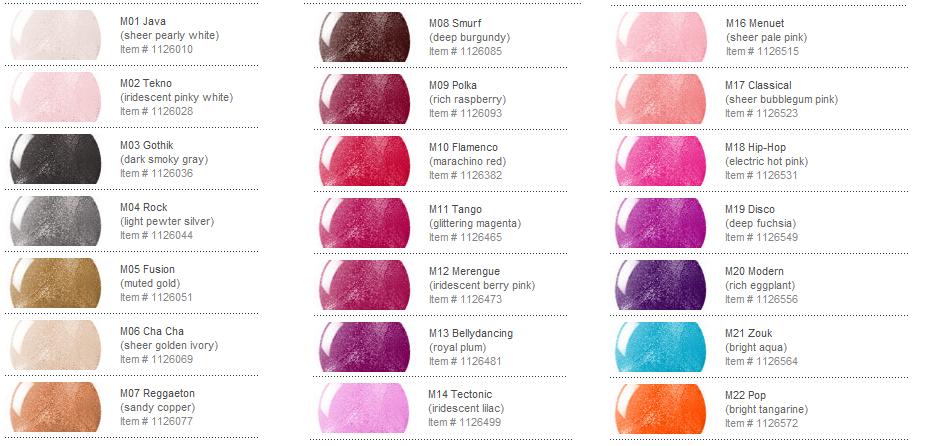
I was shopping for nailpolish online @ sephora at 2am (shut up) when I came across THIS product labeling.
This made my brain a little explody:
* Its crazy how much sense the colors make. Of course reggaeton is copper, bellydancing a plummier purple while discos a bit brighter. Of course hip-hop is electric hot pink (what other color would it be?), tecktonik is a day-glowier hip lighter pink shade. Of course zouk is cloudless sky tropical aqua, pop is shiny tangerine. Genres as aesthetics, brands, easily recognizable, lifestyles, the tribes we fall into, with even our own entire color schemes.
* Sephora is hipper than I thought or Nuwhirled is hipper than I thought. Actually, Sephora is French, so its a color palatte of whats maybe cool to listen to in Paris? Granted theres no like, cumbia colored nail polish, but still. I'm curious if this is exactly aimed at hipsterish girl fucks like me who get a kick out of zouk nail polish or diaspora chicas. Whose $$ talks?
* Errr, I actually like the colors of the genres of music I like more. My favorite colors are not just my favorite colors, but the product of some giant marketing scheme aimed exactly at me and my assumed intrests and experiences. Geez, I had no idea i was that obvious.
Ok so I'm super amused by a dutch (ngo?) called ghettoradio which posts videos and radio from the "ghettos" of Africa. Theres something really problematic about what they are doing, namely totally aestheticising the poverty of others, so I was surprised to enjoy them. The videos are mostly just walking around talking to people. Its just fun to watch a dakar bar owner talk about his business, or what a boy in soweto thinks about bob marley:
"Bob marley is more famous than anyone in South Africa"
Ive been catching up on a lot of 'African' movies this summer. I didnt like Bling, although it does have some interesting footage. The whole Democracy in Dakar series felt a little forced and one sided. Both felt too messagey w/o actually delving into the message - like, how exactly does the diamond industry function or feed war or interact with global markets, or what exactly are youth in dakar protesting and how does hiphop influence elections. Otherwise it becomes speak for vs. speak with, sort of what Johan is saying here, that great art is automatically less problematic. There are a few great films though, particularly Sissako's. He has an intersting style annndddd btw, If anyone is curious about Nollywood film, I recommend signing up to izognmovies. Not to sound like a commercial but they have a really broad collection of free or 99¢ english language nollywood films, not amazing streaming quality but def worth a few dollars to check out!
So back to ghettoradio, i think ghetto is just a weird term to use when talking about urban africa. Here, ghetto is a reclaimed word - ghettofabulous, etc. But i think its up to populations to use or reclaim that term. Ghetto comes from jewish ghettos, & is described as a "portion of a city in which members of a minority group live especially because of social, legal, or economic pressure." Which doesnt really work for African cities. The UN uses slum, legitly resisted by many, but fits better as according to wikipedia "other terms that are often used interchangeably with "slum" include shanty town, favela, skid row, barrio, ghetto, and "The Hood," although each of these has somewhat different meaning. ... By contrast, identification of an area as a slum is based solely on socio-economic criteria, not on racial, ethnic, or religious criteria." So i'll just go with 'informal settlements found in cities in the developing world, most which lack clean water, electricity, sanitation and other basic services.' which = ~ 50-90% of most urban populations. Thus, not a minority with its own subculture but most people in cities, whose music culture often dominates national radio.
After rolling my eyes at the Fader's mini presentation of Coupé-Décalé, especially the comment "I could get all anthropological and delve into the context of it but other more knowledgable people have already done that" with a link to this wikipedia article with only a wee little paragraph on Coupé-Décalé.
I've seen a lot of write-ups which describe it as a 'hot new scene' (umm at least 5yrs late) & after searching the anglosphere for better sources i found a serious lack of info. I know that new documentary is coming out which will prolly give people a better sense of the music's context and history but i figured id try to help out by adding some francophone knowledge to the mix and give Coupé Décalé its own wikipedia article. It's very adhok right now, im hoping people add and edit to what i started.
Wayne @ Wayneandwax.com has, as usual, written a really interesting post on chabbi and how it might/ might not fit into the 'ghettotech' umbrella.
If the guys in those chaabi videos were a street gang, holding guns & wearing kiffeyehs people would eat it up?
back when i was runnin my mouth, complaining about bizzarro distorted concepts of african music wayne quoted me (theantisuck) here.
I said - The roots obsessed decry Hip-Hop for losing touch with indigenous sounds. They blame American rap for destroying indigenous sounds yet they love ali farka toure, amadou &mariam, ethiopiques, ie. things that sound like American jazz and rock music. Then you have hipsters into African rap scenes, daraa j, kuduro, trying to find the music with the most dangerous street cred/booty beats and/or backpacker rap in Africa. Both “scenes” are perhaps dying yet so small and insignificant as to be nearly nonexistent next to the reality of African pop music and the actually huge scenes alive and well of coupe-decale, mbalax, swahili pop, zouk.
This isn’t to say that kuduro isn’t fascinating, especially from an academic perspective. It's just that I find it disquieting to see western audiences picking and choosing and making their own African celebrities and ideas of African music that seems so detached - in fact largely IGNORES much of the most popular African musical trends and artists celebrated across the continent. We seem to be creating our own African music scenes in our heads yet ignoring the scenes alive and kicking. Is this so bad or understandable? What are the consequences?
He responded by saying some legit points like we don’t have to listen to what's popular, shouldn’t worry too much about heisenbergian effects, and are coming from our own American, hip hop informed perspective.
Wayne asks: “Where are the Asian, Middle Eastern, or even European standard bearers for the global proles, if that’s what we’re repping?” global proles? I don’t feel like that’s what ghettotech is repping, even Wayne's stated bloggy interest is ‘American’ music, even in its broadest sense.
Ghettotech is music that is identifiably both ghetto (poor, urban, [hopefully black?]) and tech (what Wayne calls ““hip-hop logic” as well as the audibility of certain technologies and a set of sonic priorities weighted toward the low-end & the polyrhythmic”)
I feel like it would be hard to find Asian, Middle Eastern and Euro musics that fit entirely into that category. low-fi, urban, poor, sure. But they are just not engaged in the same intense dialogue with hip-hop as the Americas and Africa. I think that music comes from a totally different soundscape than that ol time triangular trade route of bodies/culture. Also not black. Race is probably an issue here.
Since runnin my mouth it turns out I was too cynical, at least about coupe decale. The mixtapes were already brewin. I can't even say I know mucho about African music anyway. Most of my knowledge is from living in Senegal in 2006 and the contacts I’ve maintained with friends there and diasporic shops/contacts. I think the distortion is also b/c African music is so mixtape/radio/adhoc spread. In Saint-Louis when I wanted to buy a cd I would tell shop owner Lamine what sounds I was interested in and ask about songs id heard at the club the night before and he would burn me a mix. no cd sales info. Even in JA, there’s trustworthy charts. So far I have been able to find no sort of trustworthy parallel African music charts. I feel like nobody has any idea what the people are actually listening to and so it’s hard to gauge context when discussing African music. If anyone begs to differ send me some links.
My orig point in that quote is that as somebody who just loves African pop music I love a lot of ghettotech music and the scenes occasionally awesome reflective engagement but find its limited scope frustrating. When I try to go to most clubs or music shops its arggg all marketed into that ol world music/nu whirled music ideas of African music. I wish there was a 3rd way audience dance/club scene that embraced global beats w/o always being ghettoed or downtempoed. But I dont think we are at a point where its easy to get direct engagement yet, so these scopes and ranges, i think, still matter. Not b/c of a few blogs influencing a music scene far away, but perhaps in terms of U.S. distribution.
An unabashed xenophile, my blog looks at emerging ideas and patterns in global pop music and its audience/reception. Unimpressed with majority music scholorship and journalism, I hope to bring my own perspective to the crowded behemoth that is music bloggery. Other intrests include tourism and nation branding, 'gayness' lived and concieved in pop, and the technologies that connect and divide us.
I recently worked for ACF doing sampling and mapping in Haiti, and will soon be heading back to school to officially pursue public health. I studied critical theory and religious studies at Hobart and William Smith in New York , as well as international relations and development at Université Gaston Berger de Saint-Louis in Senegal.
I do freelance and volunteer writing, grant-writing and french translation for non-profits in the tri-state area.